Most importers pay duties and VAT the day the container lands, even if they won’t sell or use the goods for another three months. That’s capital frozen in a warehouse. Customs-controlled storage regimes exist precisely to break that tie: they let you bring goods into Mexico and defer the tax payment until you actually withdraw them. Here’s the difference between the three that get confused the most.
The shared principle: defer, not evade
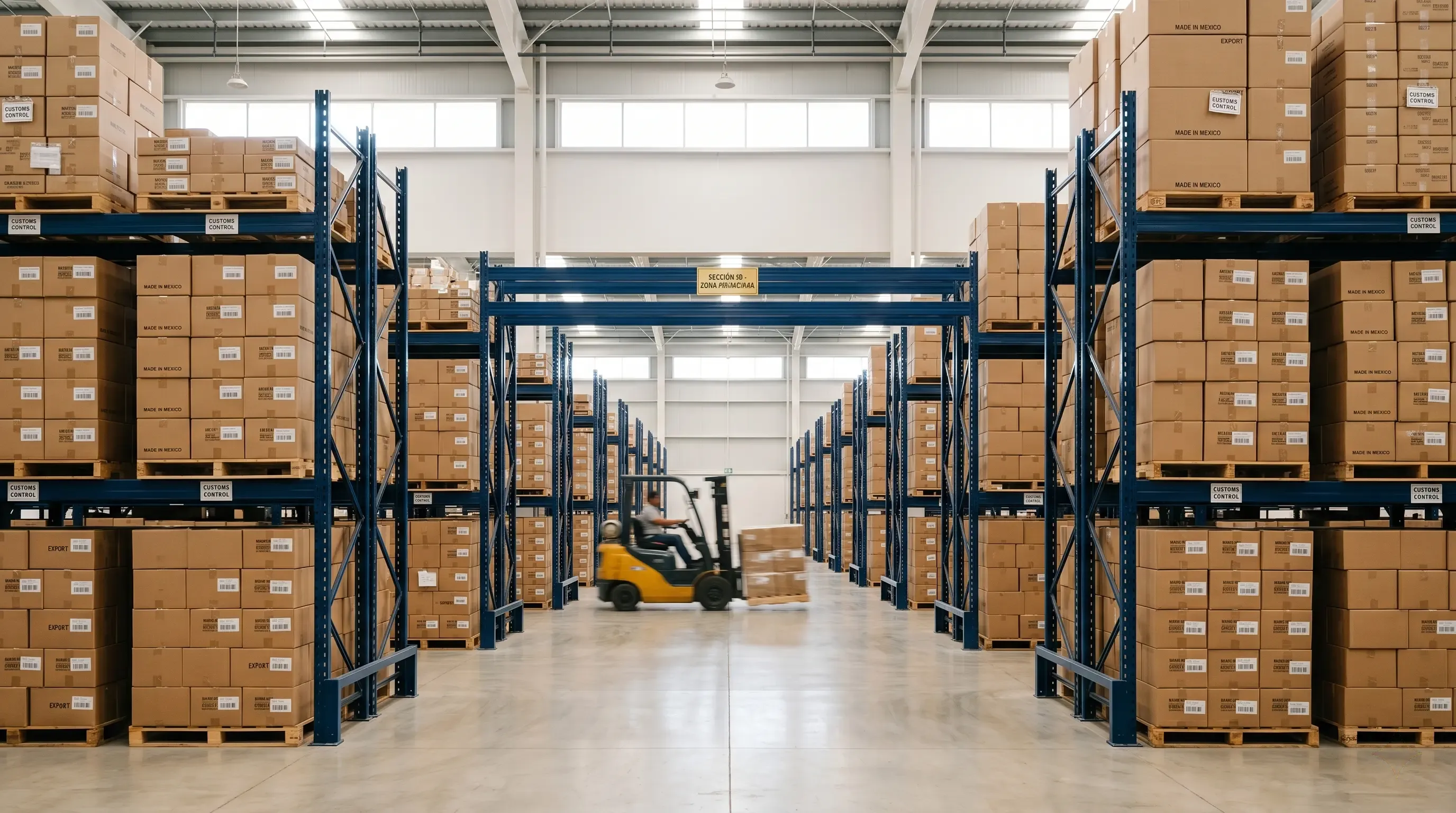
Fiscal deposit (depósito fiscal), bonded facility (recinto fiscalizado) and the Strategic Bonded Facility (Recinto Fiscalizado Estratégico, RFE) all share one logic: goods enter national territory but stay under customs control, with foreign-trade duties and VAT suspended (or not triggered) while they remain there. You pay when you withdraw them for definitive import — or you pay nothing if you re-export.
It isn’t a tax trick: it’s a formal customs regime, with its own entry document (pedimento), deadlines and inventory-control obligations. The benefit is cash flow and flexibility, not tax savings as such.
The three regimes, side by side
| Fiscal deposit | Bonded facility | Strategic Bonded Facility (RFE) | |
|---|---|---|---|
| Who operates it | Authorized General Deposit Warehouse (AGD) | Authorized private party inside a customs precinct | Company authorized for premises inside or adjacent to a bonded precinct |
| What you can do | Store, label, sample, display | Store and handle cargo in transit | Store, transform, manufacture, repair, distribute and sell |
| Taxes | Suspended until withdrawal | Suspended | Suspended (0% VAT on introduction) |
| Typical term | As long as you pay storage | Short (cargo in motion) | Up to 24 months (goods for transformation) |
| Use case | Inventory entering the market in parts | Port consolidation/deconsolidation | Manufacturing and value-add before defining destination |
Fiscal deposit: the most common for distribution
This is what importers and trading companies use when they bring in large volume and release it to the domestic market in parts. You place the full container into the fiscal deposit of a General Deposit Warehouse, and pay duties and VAT only on what you withdraw each month.
Concrete advantages:
- You don’t decapitalize by paying tax on goods you haven’t sold yet.
- You can label and meet NOM requirements inside the deposit before withdrawing (key if you arrived without Mexican labeling — see NOM labeling).
- If the product doesn’t sell, you can re-export it without having paid the definitive duty.
The downside: you pay storage to the AGD, and the regime demands rigorous inventory control. It’s not for goods that turn over in days.
Strategic Bonded Facility: the value-add regime
The RFE is the most powerful and least known. It allows you not only to store but to transform, manufacture, repair, assemble, distribute and sell goods within the facility, with taxes suspended and the introduction of foreign goods taxed at a 0% VAT rate.
It’s the natural regime for operations that:
- Import inputs, add value in Mexico and re-export (similar to IMMEX, but physically tied to a precinct).
- Want a regional consolidation and distribution point without triggering taxes until each lot’s final destination is set.
- Handle goods that may go to the domestic market or to export, and don’t want to commit the regime until the order is firm.
The term for goods destined for processing/transformation is up to 24 months, giving you far more slack than a fiscal deposit.
How to decide which one
- I just need to postpone the tax payment while I distribute → fiscal deposit.
- I’ll transform, assemble or repair before defining destination → RFE.
- I only consolidate/deconsolidate at port and stay in transit → bonded facility.
And a cross-cutting rule: if the goods turn over fast and go straight to the domestic market, you probably don’t need a storage regime — definitive import is simpler. These regimes pay off when there’s waiting, value-add or destination uncertainty.
The typical mistake: confusing a bonded warehouse with a regular one
A commercial warehouse stores goods that are already nationalized. A warehouse under a customs regime stores goods that are not yet nationalized, with taxes suspended. They are different things with opposite fiscal implications. Many importers pay all the taxes up front on arrival and then rent a warehouse — when a fiscal deposit would have given them the same thing while deferring the cash outlay.
At TradeWay
We assess with you whether your operation fits a fiscal deposit, an RFE or simple domestic storage, and what each option costs you in tied-up capital. If you buy in the United States, our warehouse in Laredo, Texas receives, consolidates and inspects your cargo before the crossing. Because we handle the full service — forwarding, customs clearance, warehousing and transport with a single invoice and a single point of contact — you don’t have to coordinate three vendors for one operation. If you’re bringing in inventory that will wait or that needs value added before entering the market, get in touch and we’ll build the scheme that frees up the most capital.