
Paying less duty and VAT by declaring a lower-than-real value sounds like an easy saving. It’s the exact opposite: undervaluation is one of the SAT’s priority enforcement targets, it’s among the easiest things to detect with the tools the authority now has, and when it’s found, the SAT doesn’t collect the “saving” — it collects far more, with surcharges, fines and, in serious cases, seizure of the goods. With the Electronic Customs Value Declaration becoming mandatory, the data cross-check is nearly instantaneous. Here’s why declaring low is the worst deal in foreign trade.
What undervaluation is
To undervalue is to declare a customs value lower than what the goods are actually worth. It can be deliberate — to pay less — or made in good faith, by not adding to the invoice price the dutiable additions the law requires (international freight, insurance, royalties, assists). The result is the same in customs’ eyes: an artificially low taxable base.
Here’s the uncomfortable part: customs doesn’t distinguish between intentional undervaluation and careless undervaluation when collecting the difference. Intent is assessed afterward, and only to aggravate the penalty. If your declared value is wrong, it’s wrong — even if you acted in good faith.
How the SAT catches it (faster all the time)
The authority no longer depends on reviewing entry by entry. It now cross-checks your declared value against several sources automatically:
| Tool | What it does |
|---|---|
| Price databases | Compares your value against transactions of identical or similar goods by other importers |
| Estimated prices | Official minimum-price lists for goods “sensitive” to undervaluation |
| Electronic Customs Value Declaration | Receives your value and worksheet before clearance and cross-checks them instantly |
| Historical entries | Detects if you lowered the value of a product you previously declared higher |
| Supplier information | Invoices, transfers and data the authority obtains through international exchange |
The bottom line: it’s no longer “let’s see if I get reviewed.” A value that doesn’t add up raises a flag directly, and the MVE speeds up that cross-check because the authority already has the figure and its backing before the container reaches port.
Estimated prices
For certain goods historically used to undervalue (textiles, footwear, some electronics, tires, tools, among others), Mexico’s Treasury (SHCP) publishes estimated-price resolutions: a minimum reference value. If you declare below that estimated price, it’s not that you can’t import — but you must guarantee the difference in duties, usually through a deposit in a customs guarantee account or a bond.
That guarantee is released if you prove, with documentation, that your real value is correct. If you don’t prove it within the deadline, the guarantee is enforced: in effect, you end up paying on the estimated price. Declaring low on goods subject to an estimated price without solid backing buys you a cash-flow problem and a potential tax assessment.
The signals that raise flags
- A value far below that of identical or similar goods on the market.
- Lowering the declared value of a product you previously declared higher, with no real change in conditions.
- EXW or FOB purchases where you declare only the invoice and don’t add international freight and insurance.
- A relationship between buyer and seller (same parent, related parties) that could affect the price, without showing it’s at arm’s length.
- A value worksheet inconsistent with the invoice, insurance policy or freight contract.
- Payments to the supplier (transfers) larger than the declared value.
What happens when the authority detects it
| Situation | Consequence |
|---|---|
| Value difference found in a review | Assessment of omitted contributions, surcharges and inflation adjustment |
| Goods subject to an estimated price without sufficient guarantee | The guarantee is enforced; you pay on the estimated price |
| Declared value below 50% of that of identical/similar goods | Precautionary seizure of the goods and start of a PAMA (Art. 151, Customs Law) |
| Undervaluation with signs of intent | Aggravated sanctions; possible criminal liability for smuggling |
| Repeat offenses / serious irregularities | Suspension of the importer registry — you can’t import |
Under debate. That 50% threshold is the one in force today. The customs reform initiative submitted with the 2027 Economic Package proposes seizure on any downward gap and lowering the infraction presumption to 20%. It isn’t law yet: see Mexico’s 2027 customs reform.
The PAMA (Administrative Procedure in Customs Matters) is the scenario nobody wants: the authority precautionarily seizes the goods while it’s resolved, which means cargo held, demurrage and storage running, and a tax assessment usually several times the duty you tried to save. Suspension of the importer registry is even worse: it halts your entire import operation, not just the troubled shipment.
The most common SME mistake
Buying FOB Shanghai, declaring as customs value only the commercial invoice amount, and omitting the ocean freight and insurance to the Mexican port. Those two items are mandatory dutiable additions: they’re part of the customs value even if they come on a separate quote. The importer thinks they’re “declaring what’s on the invoice” and is actually undervaluing. When the SAT cross-checks the carrier’s invoice against the entry, the difference jumps out on its own — and good faith is no longer the question; the amount to pay is.
How to make your declared value hold up
A defense against an undervaluation claim isn’t improvised on review day: it’s built beforehand, on every operation.
- Add every dutiable addition that applies to your purchase and keep it documented (freight invoice, insurance policy, royalty contract).
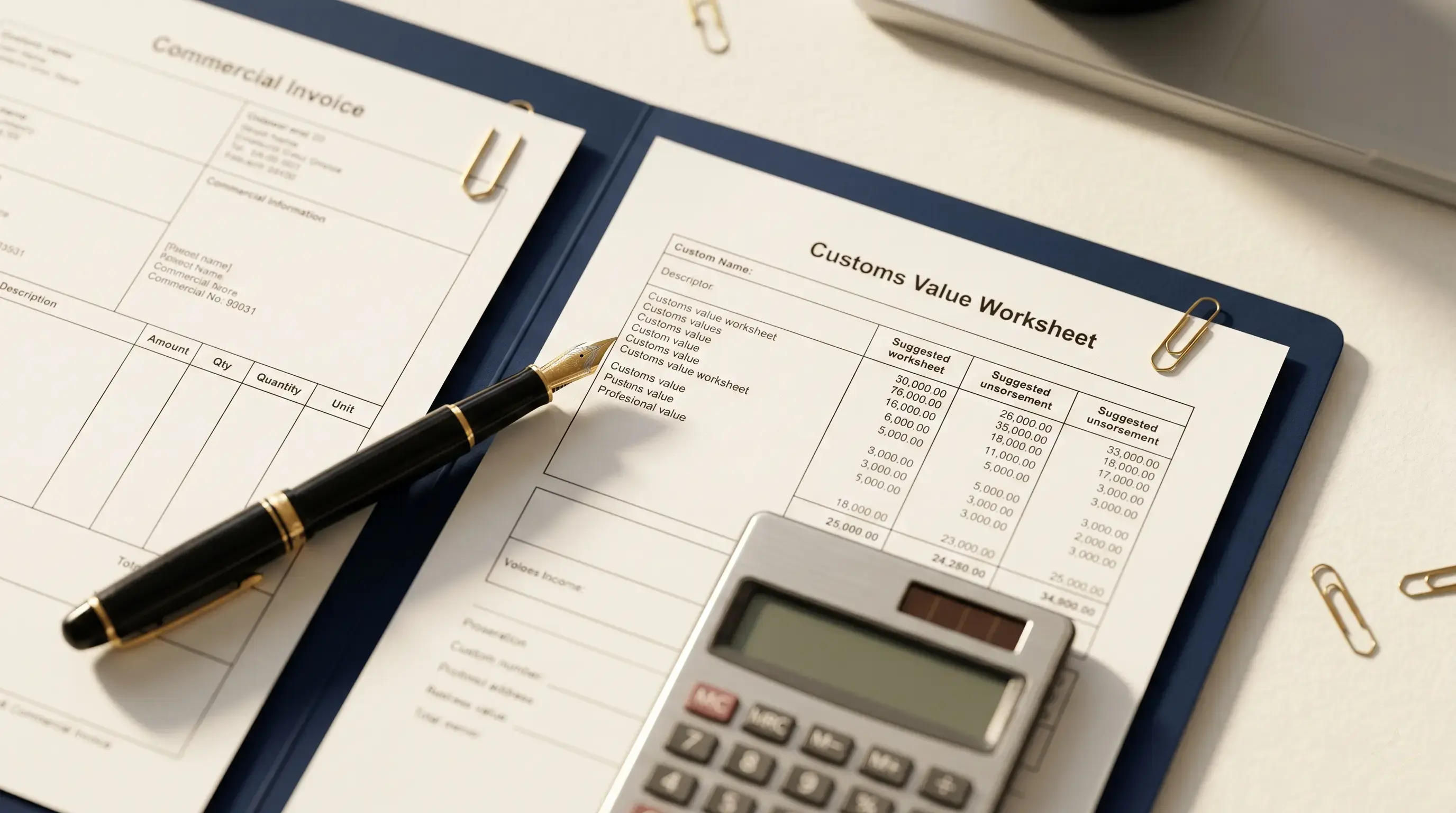
- Build the customs value worksheet so the arithmetic matches your real documents — that worksheet is your first line of defense.
- Keep the payment trail: the transfer to the supplier should match the declared value.
- If your goods are subject to estimated prices, have the backing ready to release the guarantee, not to fight it later.
- If there’s a relationship with the supplier, prepare evidence the price is at arm’s length (comparable-price studies, group pricing policy).
A well-built value doesn’t invite a review: it withstands one.
How it fits with the rest of the clearance
Undervaluation isn’t an isolated issue: it cross-references the whole clearance file.
- The customs value declaration, because the MVE is precisely where you declare the value and show how you calculated it.
- The tariff classification, because the customs value is the base on which duty is applied — and a wrong code can hide or amplify the problem.
- The customs clearance, because a questioned value stops the entry and triggers storage costs.
At TradeWay
Because we handle the full operation — forwarding, clearance and valuation under a single point of contact — we know exactly how much you paid in freight and insurance, which dutiable additions apply to your purchase, and how to build a customs value that withstands a review rather than provoking one. We help you:
- Determine the correct value including every dutiable addition, with no omissions that look like undervaluation.
- Check whether your goods are subject to estimated prices and have the guarantee and its backing ready.
- Document the operation so that, if a review comes, your file speaks for you.
If you buy EXW or FOB, or import “sensitive” goods, get in touch today and we’ll review your last operation before the SAT does.